Computing Unplugged
(Part 3: Data & Searching)
Kansas 4-H Discovery Days 2016
Indexing
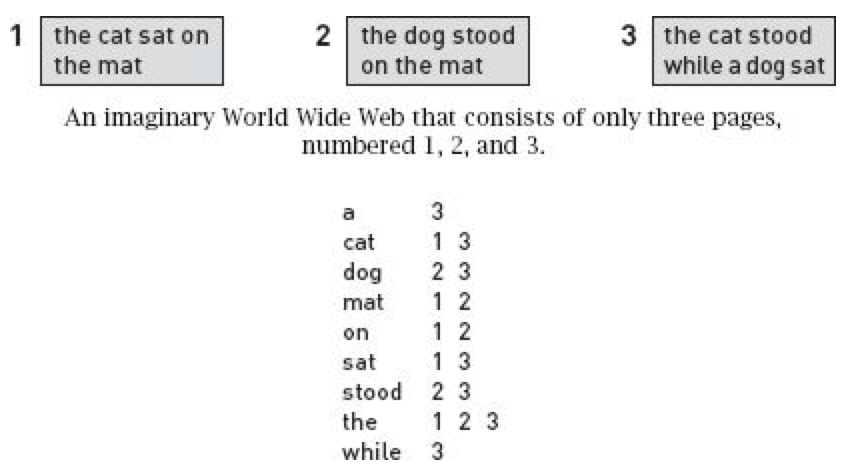
Image Source: 9 Algorithms that Changed the Future by John MacCormick
Word Location
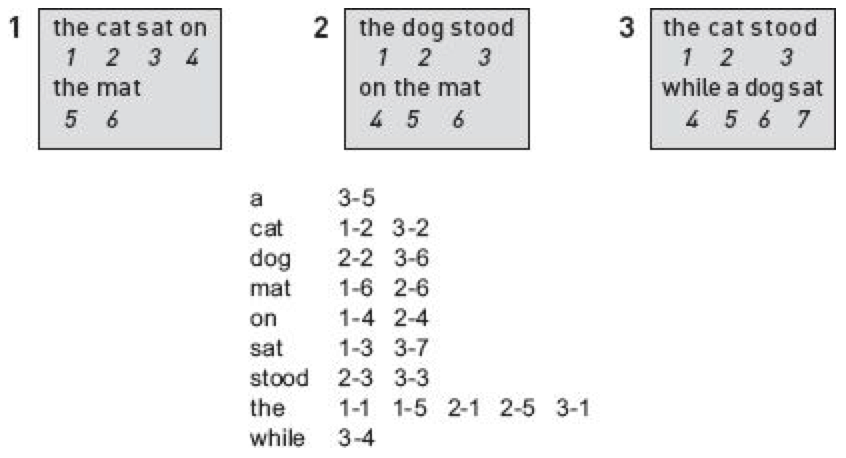
Image Source: 9 Algorithms that Changed the Future by John MacCormick
Algorithm
INPUT: a two-word phrase of form,  "Word1 Word2"
OUTPUT: an  AnswerList,  a list of the numbers of the Web pages that
contain the phrase

ALGORITHM:
(0.  The  AnswerList  starts with nothing saved in it.)

1. Extract from the table the list of  Page#-Position#  pairs for  Word1.  Call it  List1.

2. Extract from the table the list of  Page#-Position#  pairs for  Word2.  Call it  List2.

3. For each  page#-pos#  pair in List1,
      search  List2  to see if there is a pair,  page#-(pos#+1).
        (that is, the page# is the same and pos# differs by +1)
      if yes, then include  page#  in the  AnswerList.
      if no, then ignore this pair.

4. Announce all the page numbers in  AnswerList
Nearness
- Look up "cat sat" using the list
- Look up:
- cat stood
- "cat stood"
- cat OR stood
- How would that algorithm change?
Metawords
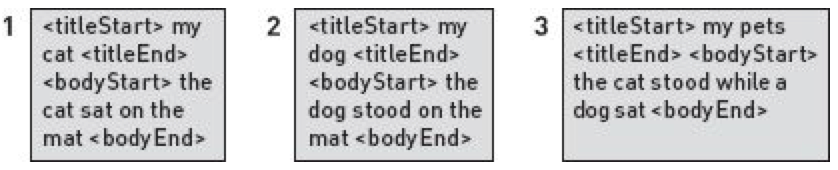
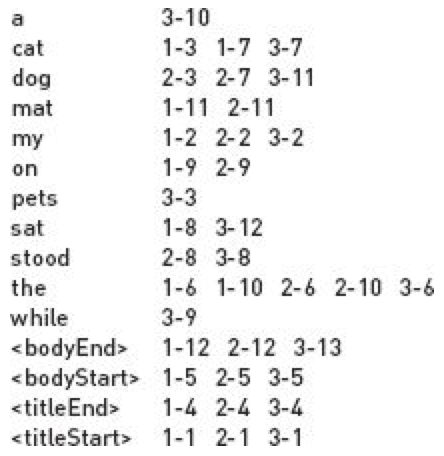
Image Source: 9 Algorithms that Changed the Future by John MacCormick
Ranking with Keywords
- Which page is more likely to be about dogs? Cats? How could you tell?
- How would you modify the algorithm to account for that?
AltaVista
- Early web search engine with crawler and indexer
- 1996: 5 servers, 210 GB storage & 4GB RAM on main indexer
- 1998: 20 servers, 500 GB storage & 130 GB RAM, 13 million queries daily
- Bought by Yahoo in in 2003, shut down in 2011
Hyperlinks
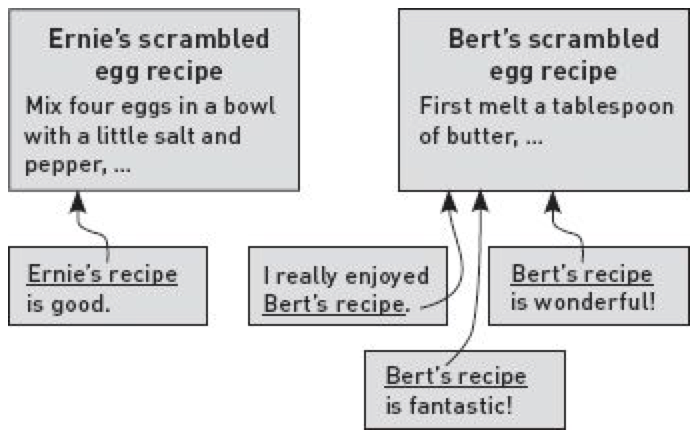
Image Source: 9 Algorithms that Changed the Future by John MacCormick
Who Wins?
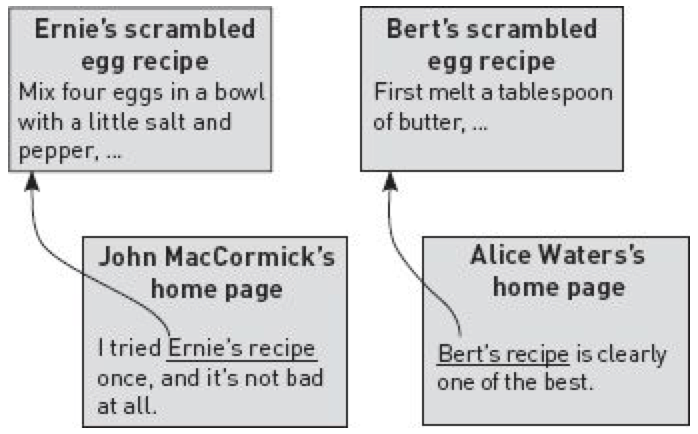
Image Source: 9 Algorithms that Changed the Future by John MacCormick
Authority
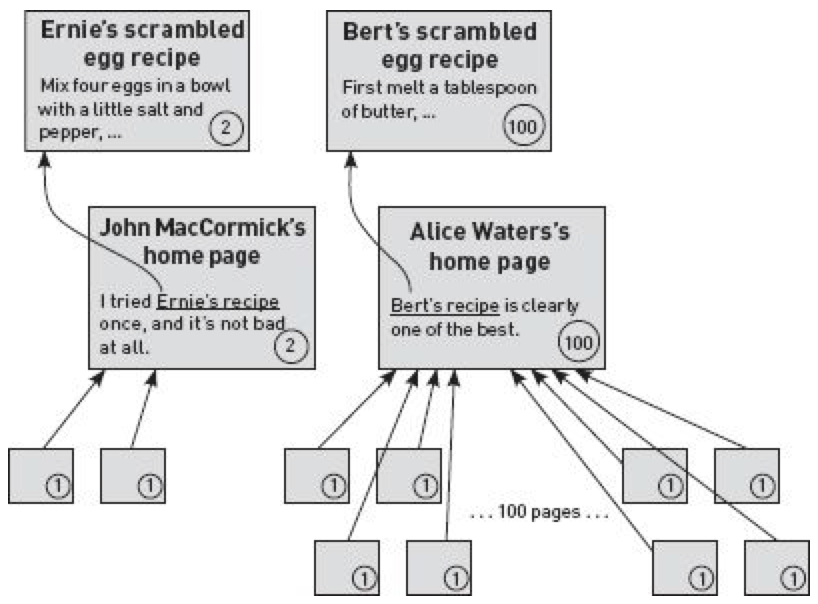
Image Source: 9 Algorithms that Changed the Future by John MacCormick
Cycles
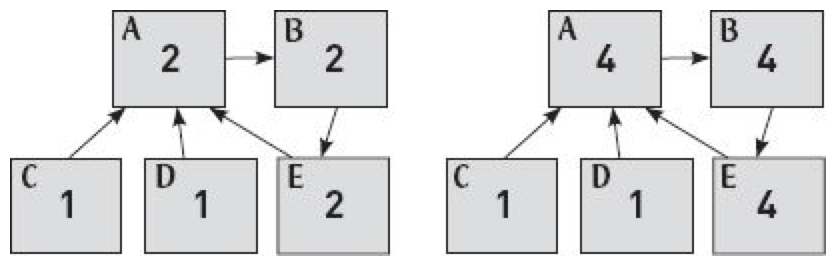
Image Source: 9 Algorithms that Changed the Future by John MacCormick
Random Surfer
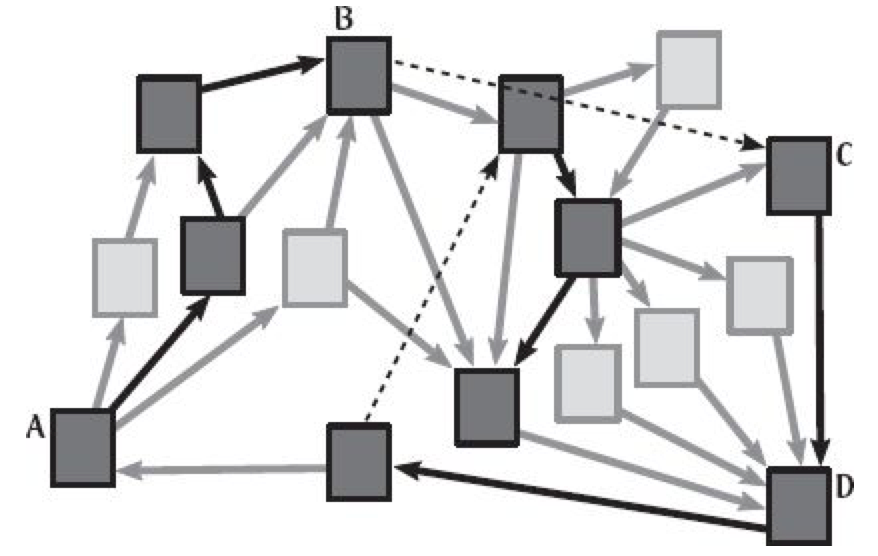
Image Source: 9 Algorithms that Changed the Future by John MacCormick
Simulate, Don't Calculate!
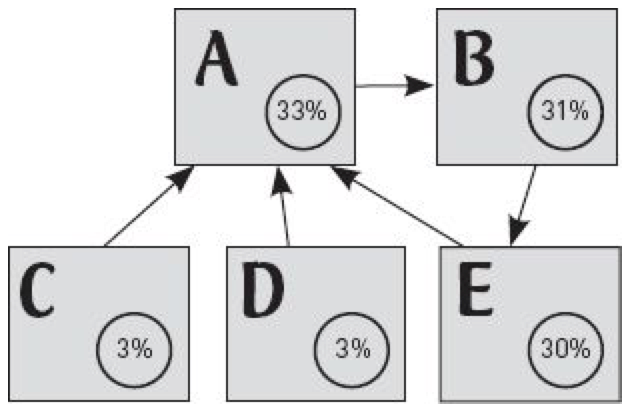
Image Source: 9 Algorithms that Changed the Future by John MacCormick
Find all paths with length < 5, calculate percentage of times each one appears (count appearances / total paths)
Problems?
- Web Spam
- Computation Time
- Non-textual Data
- Structured Data
- Others?
What is Compression?
Why is it useful?
Compression
- Resources are expensive
- Storage space
- Transmission bandwidth
- Time to read/send
- Does require more computation; can be a tradeoff
Run Length Encoding
- Find "runs" (repeated sequences) in data
- Replace them with a shorter version
- Usually the sequence and a count
RLE Example
WWWWWWWWWWWWBWWWW
WWWWWWWWBBBWWWWWW
WWWWWWWWWWWWWWWWW
WBWWWWWWWWWWWWWWW
Image Source: Wikipedia
RLE Example
WWWWWWWWWWWWBWWWW
WWWWWWWWBBBWWWWWW
WWWWWWWWWWWWWWWWW
WBWWWWWWWWWWWWWWW
12W1B12W3B24W1B15W
Image Source: Wikipedia
Wait, isn't text just numbers (ASCII)?
How can we tell which numbers are text and which are not?
RLE Example
WWWWWWWWWWWWBWWWW
WWWWWWWWBBBWWWWWW
WWWWWWWWWWWWWWWWW
WBWWWWWWWWWWWWWWW
Image Source: Wikipedia
Escape Coding
WWWWWWWWWWWWBWWWW
WWWWWWWWBBBWWWWWW
WWWWWWWWWWWWWWWWW
WBWWWWWWWWWWWWWWW
WW12BWW12BB3WW24BWW15
Image Source: Wikipedia
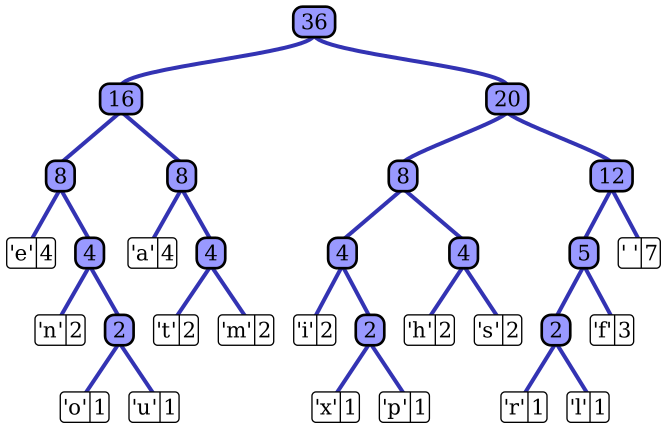
Huffman Coding
- Count the occurrences of each character
- Make a binary tree with the data
- The paths of the tree give the codes
Huffman Example
THIS IS AN EXAMPLE OF
A HUFFMAN TREE
288 bits (8 * 36)
Image Source: Wikipedia
Huffman Example
THIS IS AN EXAMPLE OF
A HUFFMAN TREE
- space: 7
- a: 4
- e: 4
- f: 3
- h: 2
- i: 2
- m: 2
- n: 2
- s: 2
- t: 2
- l: 1
- o: 1
- p: 1
- r: 1
- u: 1
- x: 1
Image Source: Wikipedia
Huffman Example
THIS IS AN EXAMPLE OF
A HUFFMAN TREE
0110 1010 1000 1011
111 1000 1011 111
010 0010 111 000 10010
... (135 bits)
Image Source: Wikipedia
What is Error Checking?
Why is it useful?
What is Error Checking?
Why is it useful?
Intuition - Squeezing
Hello there
Hello there
Hello ghere
Hello ghere
Simple - Addition
Hello there

72 101 108 108 111 32
116 104 101 114 101 33
= 1101
Simple - Addition
- If we only have the sum, can we recover the original?
- How well does this detect errors?
- Are there errors it cannot detect?
- 1101 is larger than 8 bits. How should we handle that?
- Can we do better?
Better - Pinpoint
4837543622563997
| 4 |
8 |
3 |
7 |
? |
| 5 |
4 |
3 |
6 |
? |
| 2 |
2 |
5 |
6 |
? |
| 3 |
9 |
9 |
7 |
? |
| ? |
? |
? |
? |
|
Better - Pinpoint
| 4 |
8 |
3 |
7 |
2 |
| 5 |
4 |
3 |
6 |
8 |
| 2 |
2 |
5 |
6 |
5 |
| 3 |
9 |
9 |
7 |
8 |
| 4 |
3 |
0 |
6 |
|
483725436822565399784306
Better - Pinpoint
483725436827565399784306
| 4 |
8 |
3 |
7 |
2 |
2 |
| 5 |
4 |
3 |
6 |
8 |
8 |
| 2 |
7 |
5 |
6 |
5 |
0 |
| 3 |
9 |
9 |
7 |
8 |
8 |
| 4 |
3 |
0 |
6 |
|
|
| 4 |
8 |
0 |
6 |
|
|
Better - Fletcher's Checksum
INPUT:  a data word (e.g., a sequence of ASCII-numbers)
OUTPUT: two checksums for the word, each sized to fit
        in one byte

ALGORITHM:
1. divide the  Word  into a sequence of equally-sized
   blocks, b1 b2 ... bn
2. define two checksums, starting at  C1 = 0  and  C2 = 0
3. for each block, bi,
        add  bi to  C1
        add the new value of  C1  to  C2
4.  compute  Checksum1 = C1 mod 255 and
    Checksum2 = C2 mod 255
5.  return  Checksum1  and  Checksum2
Better - Fletcher's Checksum
72 101 108 108 111 32 116 104 101 114 101 33
| Block |
C1 |
C2 |
| 72 |
72 |
72 |
| 101 |
173 |
245 |
| 108 |
281 |
526 |
| 108 |
389 |
915 |
| Total: |
1101 (81) |
7336 (96) |
Testing Fletcher's
- 72 101 108
- 72 108 101
- 74 99 108
- 72 101 0 108
- Which ones does it catch?
Cyclic Redundancy Check (CRC)
Input: 010100001001
Check: 1011

    010100001001
XOR  1011
    ------------
        10001001
    XOR 1011
       ---------
        00111001
      XOR 1011
         -------
           10101
       XOR 1011
          ------
  Checksum: 011
Hash Codes
Choose a "hash base", b (e.g., b= 2 or b= 10 or b= 37)

For a word of integers of length n+1:
    w =  x0 x1 x2 ... xn-1 xn,

Compute this hash number:
    hash(w) =  (x0 * bn) + (x1 * bn-1) + (x2 * bn-2) + ...
               (xn-1 * b1) + xn
Hash Codes
For  word = 4 5 6,
when  b = 10,
     hash(word) = (4 * 102) + (5 * 101) + 6  =
     400 + 50 + 6  =  456
when b = 100,
     hash(word) = (4 * 1002) + (5 * 1001) + 6  =
     40000 + 500 + 6  =  40506
when b = 5,
     hash(word) = (4 * 52) + (5 * 51) + 6  =
     100 + 20 + 6  =  126
when b = 2,
     hash(word) = 16 + 10 + 6 =  32
when b = 1,
     hash(word) = 4 + 5 + 6 = 15
Hash Codes
For word = 12 33 08,
when b = 10,
     hash(word) = (12 * 102) + (33 * 101) + 8  =
     1200 + 330 + 8  =  1538
when b = 100,
     hash(word) = (12 * 1002) + (33 * 1001) + 8  =
     120000 + 3300 + 8  =  123308
when b = 5,
     hash(word) = (12 * 52) + (33 * 51) + 8  =
     300 + 165 + 8  =  473
when b = 2,
     hash(word) = 48 + 66 + 8 =  122
Hamming Codes
BIT#:    1       2        3  4       5  6  7
        -------------------------------------------
PURPOSE: P3,5,7  P3,6,7   D  P5,6,7  D  D  D

where  D  is a data bit, and
Pa,b,c,...  is the parity bit for data bits at  a,b,c,...

Examples:
DATA 3 5 6 7  P3,5,7  P3,6,7  P5,6,7   HAMMING CODE
------------------------------------------------------
     0 1 0 0     1       0       1     1 0 0 1 1 0 0

     1 0 1 1     0       1       0     0 1 1 0 0 1 1